


The Biopolymers of youth.
Collagen and Elastin are the foundational structural proteins of the human body. They form the biological scaffolding that determines the tensile strength and elastic recoil of your skin, joints, and organs. In the context of Indian skin phenotypes, understanding how to preserve this dermal matrix is the definitive factor in managing environmental stress and intrinsic aging.
Collagen and Elastin: The Dermal Architecture
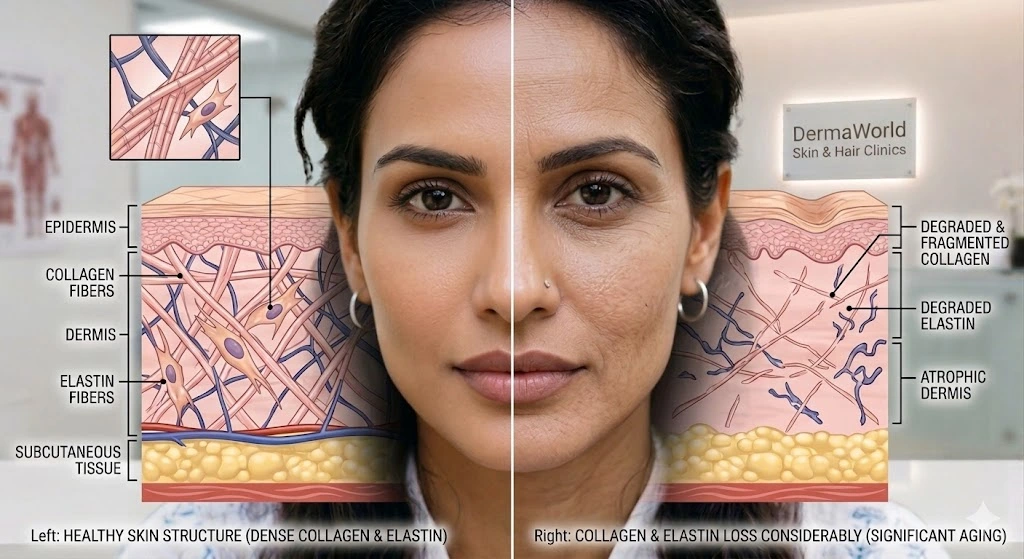
The youthful resilience and “bounce” of human skin are governed by two fundamental proteins found in the dermis: Collagen and Elastin. While Collagen provides the tensile strength (the brick and mortar), Elastin provides the recoil (the rubber bands). Together, they form a three-dimensional matrix that supports every facial movement and environmental shield.
1. Collagen: The Protein Scaffolding
Collagen makes up approximately 75% to 80% of your skin’s dry weight. In the Indian phenotype, Type I and Type III collagen are the most prevalent.
-
The Degradation Curve: Starting at age 25, the body’s natural collagen production drops by 1% to 1.5% annually.
-
The “MMP” Enzyme Factor: In high-UV environments like India, sun exposure triggers enzymes called Matrix Metalloproteinases (MMPs). These enzymes act like “molecular scissors,” slicing through healthy collagen fibers far faster than the natural aging process.
2. Elastin: The Snap-Back Mechanism
While collagen is abundant, Elastin is rare, making up only 2% to 4% of the dermis. Unlike collagen, which the body can be stimulated to produce via medical treatments, Elastin is notoriously difficult to replace once lost.
-
Solar Elastosis: Prolonged exposure to Delhi’s UV radiation causes Elastin to “clump” together rather than stay in tight, springy coils. This leads to leathery skin texture and deep, permanent creases that don’t disappear when the face is at rest.
The Indian Context: “Inflamm-aging” and Collagen Loss
A unique challenge for Indian skin is Inflamm-aging—a low-grade, chronic inflammation caused by urban pollution (PM2.5) and heat.
-
The Glycation Trap: Diets high in refined sugars and “fried” Indian snacks lead to Advanced Glycation End-products (AGEs). These sugar molecules attach themselves to collagen fibers, making them brittle and prone to breaking. This process is called “Glycation,” and it turns flexible “Type I” collagen into stiff, dysfunctional “Type III” remnants.
The Dermal Scaffolding Report
The average loss of skin collagen in the first 5 years of menopause, making clinical biostimulation a biological necessity during this transition.
The duration for which collagen-degrading enzymes remain active in your skin after just 2 hours of unprotected UV exposure in the Delhi sun.
The primary collagen types targeted by Profhilo and HIFU to restore tensile strength and elastic recoil.
THE SCIENCE OF DENTAL INTEGRITY.
A detailed anatomical perspective on how the structural scaffolding of the Indian dermal matrix transforms over time. This 60-second review compares the robust, dense fiber network of healthy skin against the fragmented, atrophic profile of collagen and elastin loss. Understanding this biological matrix is essential for effective preventative health and targeted biostimulation.
Beyond the Surface
The Science of Dermal Densification
In the Indian phenotype (Fitzpatrick IV-VI), skin aging is rarely about “fine lines” first. Instead, it manifests as Dermal Thining and Structural Laxity. Because Indian skin has a denser epidermal layer, it masks internal collagen depletion for years—until a “tipping point” is reached, leading to sudden sagging and deep-set nasolabial folds.
1. The Glycation Crisis in the Indian Diet
An uncommon but critical factor in Indian dermal health is Glycation. High-carb diets (refined flour, sugars, and fried snacks) lead to the formation of Advanced Glycation End-products (AGEs). These molecules act like “biological glue,” cross-linking with collagen fibers and turning them from flexible springs into brittle sticks. Brittle collagen cannot be repaired; it must be broken down and replaced through clinical biostimulation.
2. Solar Elastosis: The “Delhi Sun” Factor
While melanin provides some protection, the high UV index in North India triggers Solar Elastosis. This is the abnormal accumulation of elastic tissue in the dermis. Instead of tight, springy coils, the elastin becomes thick, tangled, and dysfunctional. This is what creates the “leathery” texture often seen in sun-exposed Indian skin, requiring deep-reaching energy treatments to reboot the matrix.
Clinical Biostimulation
Rebuilding the Scaffolding
Preserving collagen is a passive strategy; Biostimulation is the active medical intervention. At DermaWorld, we utilize a multi-modal approach to trigger the body’s natural wound-healing response, which in turn forces fibroblasts to synthesize new Type I Collagen.
The Collagen-Restoration Matrix
| Clinical Objective | The Biological Mechanism | Primary Interventions |
|---|---|---|
| Volumetric Scaffolding | Replacing deep structural loss and lifting sagged tissues. | Dermal Fillers | Silhouette Soft |
| Deep SMAS Lifting | Utilizing focused ultrasound to contract the deep muscle layer. | HIFU Non-Surgical Lift |
| Dynamic Line Relaxation | Preventing the mechanical breakdown of elastin from repetitive movement. | BOTOX® | Anti-Wrinkle Triage |
| Bio-Remodeling | High-concentration Hyaluronic Acid stimulating 4 types of collagen. | Profhilo® Treatment |
| Follicular Support | Using growth factors to strengthen the dermal papilla around roots. | PRP Therapy |
| Surface Refinement | Removing pollutants and triggering rapid epidermal turnover. | Carbon Laser Peel | Cosmelan® Peels |
| Cellular Hydration | Deep-pore detoxification to reduce dermal oxidative stress. | HydraFacial™ MD | Medi-Facials |
| Submental Contouring | Permanently dissolving fat cells to redefine the jawline “frame.” | Kybella® Reduction |
| Pigment & Tone | Utilizing low-energy laser to shatter melanin and stimulate repair. | Laser Toning |
The “Silent Aging” Preventative Strategy
For the younger audience, the goal is Collagen Banking. By starting with non-invasive Laser Toning or Medi-Facials in the late 20s, you create a “dermal surplus.”
It is important to remember that collagen isn’t just an adult concern; pediatric skin health sets the foundation for lifetime resilience. Proper Pediatric Dermatology focuses on barrier protection in early years, which prevents the chronic inflammation that leads to early collagen degradation later in life.