


Best Laser Tattoo Removal in Delhi by Experienced Skin Doctor
We employ the state-of-the-art Q-Switch laser for best laser tattoo removal in Delhi. It is a very effective method with minimal risk of scarring and lesser pain. Other options are also available too, like Dermabrasion, salabrasion, Excision and Removal Creams but they might be little painful and take time to heal.
For tattoo removal, you can find us in West Delhi (Rajouri Garden, New Rajinder Nagar, Sir Ganga Ram, & Karol Bagh).
Safe, Scar-Free Tattoo Removal in Delhi
Looking for the Best Laser Tattoo Removal in Delhi means ensuring deep ink pigments are shattered cleanly without burning your surface skin. At DermaWorld Skin & Hair Clinics, treatments are personally supervised by senior dermatologist Dr. Rohit Batra. We calibrate medical Q-Switched and Picosecond laser platforms to fade dark and multi-colored ink safely across Indian skin tones without leaving ghost marks or scars.
Advanced Laser Tattoo Removal in Delhi
Safe Pigment Clearance
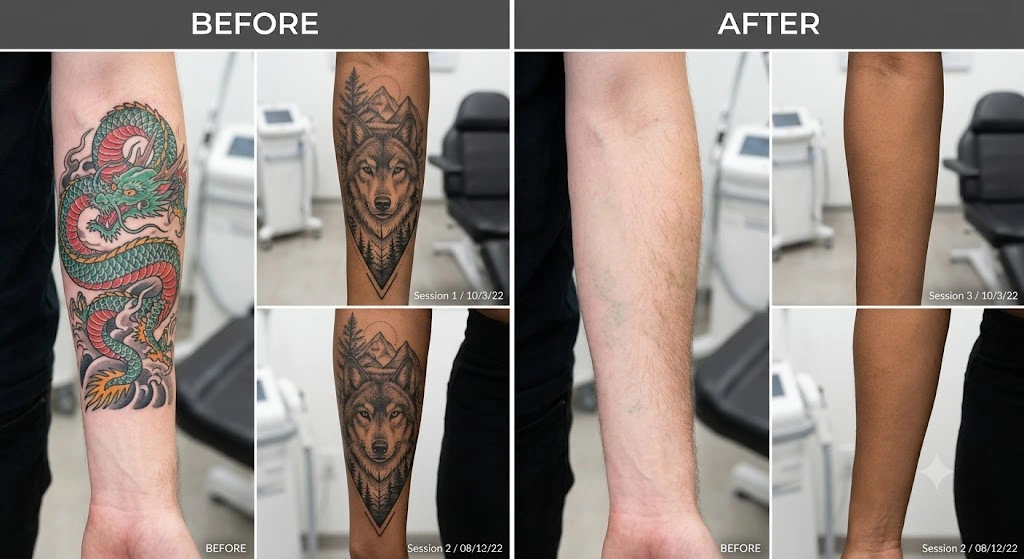
Tattoos are created to last a lifetime. Needle punctures deposit synthetic and mineral pigments deep into the reticular dermis—the lower structural layer of your skin. Because these ink particles are vastly larger than your white blood cells, your body cannot naturally break them down or wash them away.
Older techniques like dermabrasion (scraping the skin), salabrasion (salt scrubbing), or surgical cutting intentionally damage the surface layers, almost always causing thick, disfiguring scars.
Modern medical laser dermatology eliminates this risk entirely. By applying soundwave-based light pulses directly into the skin, the ink is fragmented without tearing the delicate dermal-epidermal boundary. All procedures follow the strict safety parameters set by the National Medical Commission.
How Does Laser Tattoo Removal Work?
The Removal Process
A major misconception is that lasers burn ink off the surface of your body. In reality, modern medical lasers work through Photoacoustic Shockwaves (pressure waves generated by light) rather than thermal heat:
1. Light Absorption
The laser directs concentrated pulses of light lasting just billionths (nanoseconds) or trillionths (picoseconds) of a second into the skin. The trapped ink particles absorb this energy instantly.
2. Acoustic Shattering
Think of the encapsulated ink cluster as a large boulder. The rapid acoustic shockwave shatters this boulder into microscopic pebbles and ultra-fine dust without heating surrounding tissue.
3. Natural Elimination
Once reduced to micro-dust, your immune system’s scavenger cells (macrophages) engulf the ink debris and flush it out naturally through your lymphatic drainage pathways over the following weeks.
Because your immune cells need adequate time to clear away fragmented pigment, sessions are strictly scheduled 6 to 8 weeks apart. Rushing appointments does not speed up fading; it only stresses healing tissue. Proper resting intervals ensure continuous ink clearance while keeping your natural skin barrier healthy and intact.
Ready to Safely Clear or Fade Your Tattoo?
Schedule a comprehensive evaluation with Dr. Rohit Batra to analyze your ink depth, tattoo colors, and skin type for a personalized clearance roadmap.
Types of Tattoos We Treat
Tattoo Categories
Every tattoo behaves differently under laser energy depending on ink depth, chemical pigments, and how it was applied. We tailor our protocols across four main categories:
- Professional Tattoos: Applied with motorized tattoo guns that pack dense synthetic dyes deep and evenly into the reticular dermis. These require sequential passes to break down layered pigment blocks.
- Amateur & Homemade Tattoos: Usually created using hand needles and India ink, charcoal, or soot. The ink is deposited at irregular depths and is generally less dense, often clearing in fewer sessions than professional artwork.
- Cosmetic Eyebrows & Lip Liners: Semi-permanent microblading and cosmetic inks frequently contain titanium dioxide and iron oxides. These require careful test spots to prevent the pigments from darkening unexpectedly upon laser contact.
- Traumatic Tattoos: Occur when graphite, asphalt, or gunpowder embeds deep into the tissue following an accidental abrasion or injury. Selective laser energy fractures these foreign particles without surgical excision.
Ink Color & Wavelength Precision
Ink Wavelengths
Every distinct tattoo dye binds to and absorbs a particular frequency of light energy. Using an incorrect laser frequency will fail to clear pigment and may cause unnecessary skin irritation. We match precise wavelengths to each specific ink shade:
| Laser Modality | Target Color & Wavelength | Acoustic Mechanism | Clinical Strategy |
|---|---|---|---|
| Q-Switched Nd:YAG | Black & Dark Navy (1064 nm) | Nanosecond Acoustic Pulse | Deep dermal penetration; safely bypasses surface melanin on Indian skin. |
| Frequency-Doubled Nd:YAG | Red, Orange & Purple (532 nm) | Superficial Targeted Pulse | High pigment absorption; uses calibrated spot sizes to prevent surface blistering. |
| Q-Switched Alexandrite | Resistant Green & Sky Blue (755 nm) | Selective Resonance Wave | Targets stubborn mineral dyes without affecting surrounding healthy tissue. |
| Picosecond Laser Array | Multi-Colored Ink & Ghost Shading | Ultra-Short Pressure Wave | Zero heat effect; pulverizes ink into ultra-microscopic dust for faster lymphatic clearance. |
Protecting Indian Skin Tones (Fitzpatrick IV–VI)
Skin Safety
Removing tattoos on brown skin requires medical expertise. Melanin-rich skin naturally contains high levels of protective pigment in the upper layers. If an uncalibrated, high-heat salon machine is used, the laser’s heat is absorbed by your natural skin pigment rather than the tattoo ink. This leads to two major complications:
Avoiding “Ghost Outlines”
Excessive heat can destroy your natural pigment-producing cells (melanocytes), leaving behind a permanent, chalky white silhouette (hypopigmentation) of the removed tattoo. Our acoustic lasers preserve your natural melanin.
Preventing Rebound Darkening
Thermal burns irritate deeper skin cells, triggering Post-Inflammatory Hyperpigmentation (PIH)—a dark, muddy patch over the area. Calibrated acoustic pulses fragment ink without thermal burns.
Our medical team applies this same precision across all our laser and skin treatments, from gentle laser toning to specialized pigment clearing with Cosmelan depigmentation peels.
How Many Sessions Will You Need?
Session Timeline
Complete tattoo clearance requires multiple sessions. At DermaWorld, we do not guess; we calculate your session roadmap using the medically validated Kirby-Desai Scale:
- Skin Phototype: Indian skin tones require conservative energy fluences and full 6-to-8 week resting intervals to ensure complete barrier safety.
- Location on the Body: Tattoos located on the face, neck, or upper chest clear faster due to rich blood circulation and active lymph nodes. Areas further away, like fingers, wrists, and ankles, take longer.
- Ink Density & Layering: Heavy, solid tribal fills and cover-up designs contain multiple layers of dense ink, requiring more passes than fine line shading.
- Existing Scar Tissue: If an amateur needle scarred your skin during tattooing, that scar tissue traps ink particles and slows down cellular clearance.
- Immune Health: Drinking plenty of water, staying physically active, and avoiding smoking helps your body flush out fragmented ink particles much faster.
Pre-Care and Post-Care Instructions
Care Guidelines
Following proper clinical guidelines before and after your sessions ensures comfortable treatments and clean results:
Before Your Session
Keep the target skin completely protected from direct sunlight and tanning for at least 14 days before your visit. Do not apply bleaching formulas or harsh chemicals, and shave the treatment area the night before your appointment.
After Your Session
Keep the treated area clean and dry for the first 24 hours. Apply the prescribed soothing barrier ointment. Avoid hot showers, steam rooms, and heavy gym workouts for 48 hours. If tiny pinpoint scabs form, let them flake off naturally without picking.
Dermatology & Laser Excellence in West Delhi
Clinic Expertise
Led by Dr. Rohit Batra—senior consultant dermatologist with associations at premier medical institutions including Sir Ganga Ram Hospital—DermaWorld provides patient-first aesthetic care across Rajouri Garden and New Delhi.
Whether you require scar-free tattoo removal, clinical care for deep marks with melasma and hyperpigmentation treatment, or restorative skin rejuvenation with medi-facials, our clinic delivers evidence-based treatments tailored to your skin’s biological needs.
Frequently Asked Questions
Laser Tattoo FAQs
Is laser tattoo removal painful?
Will the laser leave a scar on my skin?
What is the white “frosting” that appears immediately after treatment?
Can I place a new cover-up design over the treated area?
Do DIY tattoo removal creams work?
Can an old, heavy cover-up tattoo be cleared?
Start Your Tattoo Removal Journey Today
Visit DermaWorld in Rajouri Garden, West Delhi, for a personalized skin assessment and transparent session plan based on your tattoo’s size and ink profile.