

Best Pimple/Acne Treatment in Delhi
No need to give up on Acne/Pimple issues. Visit India’s best Dermatology & Acne Clinic in Delhi. Dr. Rohit Batra offers the best Acne treatment in Delhi with satisfactory results.
Recurring breakouts are rarely just a superficial skin flaw—they are external symptoms of localized inflammation, follicular obstruction, or systemic hormonal shifts. At DermaWorld Skin & Hair Clinic, under the leadership of Dr. Rohit Batra, we move beyond generic over-the-counter drying lotions that only irritate the epidermis. By utilizing advanced diagnostic tools to trace the biological root cause of your breakouts, we craft personalized, medical-grade protocols to stop active acne, clear deep-seated congestion, and safeguard your skin against future permanent scarring.
Widespread confusion surrounding Acne Treatment in Delhi often leads individuals to opt for temporary salon treatments or generic cosmetic products. Acne vulgaris is a multi-factorial skin pathology that originates within the pilosebaceous unit (the hair follicle and its connected oil gland). To build a reliable solution for persistent breakouts, a clinical assessment must evaluate your unique rate of sebum production, bacterial colonies, and dead skin cell turnover.
The Biological Root Causes of Acne & Breakouts
Pathophysiology of the Pilosebaceous Unit
The genesis of a pimple progresses through four linked cellular stages. First, the sebaceous glands produce an excess amount of oil (sebum), a process frequently triggered by fluctuating androgen hormones. Second, dead skin cells do not shed properly, sticking together and trapping sebum inside your pores. This process, known as follicular hyperkeratinization, creates a low-oxygen environment perfect for the overgrowth of Cutibacterium acnes bacteria, leading to the painful swelling and redness of inflammatory acne.
Many individuals struggle with stubborn adult breakouts that resist traditional acne products. In these cases, systemic underlying elements are often at play. For instance, women dealing with cyclical breakouts along the lower third of the face or jawline are frequently experiencing hormonal fluctuations related to polycystic ovary syndrome, which requires specialized care from an experienced PCOS skin consultant or adult medical expert to address the internal triggers.
Anatomical Progression: Inside the Pilosebaceous Unit
Visualizing the Four Stages of Acne Pathology
To effectively resolve persistent breakouts, it is essential to understand the structural mechanics occurring beneath the skin’s surface. Below is a detailed anatomical breakdown mapping how a healthy skin follicle transitions into an inflamed acne lesion through four distinct pathological steps.
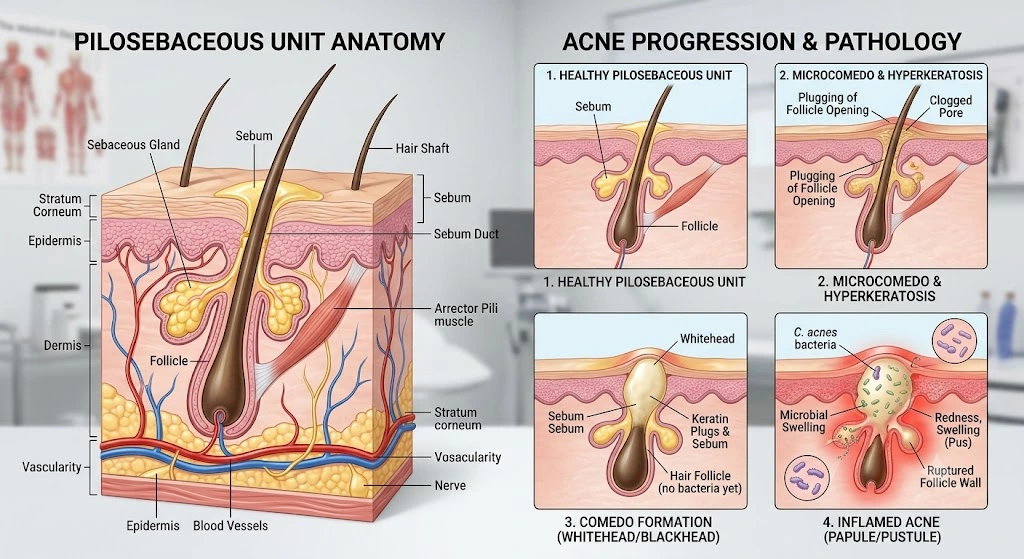
*Medical illustration detailing the transition from a healthy pilosebaceous unit to microcomedo formation, non-inflammatory comedo development, and inflamed pustular rupture.*
The Four Stages of Breakout Development
Hormonal Dynamics & The Reality of Adult Acne
U-Zone Breakout Patterns
Unlike teenage breakouts which typically show up across the oilier T-zone (forehead and nose), adult acne tends to form a distinct “U-zone” pattern along the jawline, chin, and neck. These deep, sensitive, cyst-like bumps are highly resistant to typical topical drying treatments.
Effectively managing adult acne requires a comprehensive medical evaluation. By checking underlying metabolic factors and hormone levels, we can design specialized internal protocols that complement your external clinical treatments for long-term clarity.
The Direct Impact of Modern Stress & Pollution
When your body encounters chronic stress or high levels of airborne pollutants, it releases a surge of cortisol. This hormone directly stimulates your sebaceous glands to produce heavier, stickier oil.
This microscopic alteration compromises the skin’s vulnerable microbial balance, worsening follicular blockages and triggering acute inflammatory flare-ups. Learn more about how these micro-particles degrade cells in our resource on how pollution affects skin.
Understanding Acne Treatment Costs in Delhi: Unit & Modality Logistics
Clinical Pricing & Modality Frameworks
One of the most frequent question from individuals or patients searching for the Best Acne Treatment in Delhi is about the price or have the concern for the overall cost. True clinical dermatology avoids flat commercial price tags because your acne grade dictates the technical resources required. “Clearing mild, non-inflammatory whiteheads requires a completely different clinical method than subduing deep, tender cystic nodules through high-precision light modalities.”
To give complete clarity to our patients, professional dermatology care breaks down pricing on a per-modality or per-session framework. Investing in custom, target-specific dermatological treatments prevents the common cycle of wasting money on standard over-the-counter vanity products that fail to repair the pilosebaceous unit.
| Clinical Intervention | Acne Severity Target | Average Price Range (Per Session) | Primary Biological Advantage |
|---|---|---|---|
| Salicylic & Glycolic Peels | Grade I to II (Blackheads & Papules) | ₹2,500 – ₹4,500 | Unclogs impacted hair follicles; regulates baseline sebum production. |
| Advanced Carbon Laser Peel | Grade II to IV (Active Pustules & Severe Oily Skin) | ₹4,000 – ₹7,500 | Vaporizes carbon debris within the pores; targets and destroys acne-causing bacteria. |
| Laser Toning & Photo-Therapy | Grade III & IV (Deep Red Inflammatory Lesions) | ₹5,000 – ₹9,000 | Calms overactive vascular redness; stimulates cellular epidermal repair. |
| Intralesional Injections | Severe Nodulo-Cystic Swelling | ₹1,500 – ₹3,000 (Per cyst) | Delivers localized, fast-acting relief to flatten major cysts within 48 hours. |
Clinical Grading of Acne Vulgaris & Targeted Therapies
Four-Tier Medical Grading System
At our clinic, we do not believe in a one-size-fits-all approach to skincare. To achieve optimal results for the Best Acne Treatment in Delhi, we meticulously evaluate and categorize your breakouts into four distinct clinical grades. This systematic sorting ensures that your treatment plan is precisely aligned with the severity of your skin condition, maximizing safety and tracking clear progress.
| Acne Severity | Primary Skin Symptoms | Clinical Action Plan | Targeted Technologies Used |
|---|---|---|---|
| Grade I (Mild) | Open and closed comedones (blackheads and whiteheads); minimal inflammation. | Deep follicle exfoliation and professional pore clearance. | Medical Comedone Extraction & Specialized Salicylic Peels. |
| Grade II (Moderate) | Frequent papules and pustules (raised, red bumps and surface pimples). | Targeted topical anti-microbials combined with advanced cell renewal. | Anti-bacterial Light Therapy & Tailored facial peels. |
| Grade III (Severe) | Widespread, deeply inflamed papules, painful pustules, and early nodules. | Systemic medication management combined with deep laser clearing. | Advanced laser toning & Prescription-Led Protocols. |
| Grade IV (Cystic) | Deep, painful, interconnected nodules, fluid-filled cysts, and a high risk of permanent scarring. | Aggressive scar prevention protocols and deep-tissue structural healing. | Targeted Intralesional Injections & Specialized carbon laser peel. |
Post-Acne Damage: Decoupling PIH from PIE Marks
Pigmentation Versus Vascular Lesions
A critical element routinely overlooked in standard skincare discussions is the biological distinction between post-breakout discoloration types. When an active pustule resolves, it frequently leaves behind persistent marks that patients mistake for permanent scars. In Indian skin phenotypes (Fitzpatrick IV–VI), this discoloration splits into two entirely different cellular pathways: Post-Inflammatory Hyperpigmentation (PIH) and Post-Inflammatory Erythema (PIE).
Post-Inflammatory Hyperpigmentation (PIH) manifests as flat brown, tan, or slate-gray spots caused by overactive melanocytes depositing pigment into the epidermis and dermis. Conversely, Post-Inflammatory Erythema (PIE) presents as discrete red, pink, or purplish macules caused by damaged or dilated capillary micro-vessels beneath the surface rather than excess melanin.
Treating dark pigment effectively requires targeted tyrosinase inhibition or photoacoustic clearance, whereas red vascular lesions require specific vascular-calibrated wavelengths to safely collapse fragile capillary pools.
To understand why standard brightening creams often fail to resolve these marks, explore our clinical guide on why red and dark acne marks fail to fade with over-the-counter creams.
“Utilizing improper techniques for post-breakout marks significantly compromises the skin recovery process. Applying aggressive skin-lightening creams to red vascular marks triggers localized irritation and barrier breakdown. Accurate diagnostic mapping between vascular dilation and melanin deposition is the first essential step to achieving a clear, smooth complexion safely.”
The Local Epidemic: The Dangers of Dermal Self-Medication
Risks of Unprescribed Topical Steroids
A widespread challenge we routinely see among patients seeking a Pimples Treatment in Delhi is the hidden damage caused by self-medicating with over-the-counter creams. Many individuals pick up potent triple-combination steroid creams based on advice from retail pharmacies or non-medical sources. While these creams might offer a brief reduction in swelling, prolonged use can cause significant harm to your skin’s natural architecture.
Relying on these unprescribed formulas suppresses local immunity, thinning the skin over time and often triggering a severe, stubborn rebound condition known as Topical Steroid Damaged Face. To learn more about this public health issue, read our detailed report on how steroids age skin and discover our stance on the hazards of dermal self-medication to understand why specialist-guided care remains crucial.
Advanced Modalities for Acne Clearance & Scar Prevention
Specialized Clinical Procedures
To ensure lasting clarity, our practice combines advanced technology with medical expertise. Below, we break down several specialized clinical procedures used to resolve active breakouts and protect your skin against future texture changes or permanent markings.
Unlike basic cosmetic options, medical-grade peels use specific, concentrated combinations of alpha and beta hydroxy acids (such as pure Salicylic and Mandelic acids) to dissolve the cellular glue keeping dead cells trapped inside your pores. This advanced exfoliation flushes out deep congestion, calms active surface inflammation, and balances oil production without stripping away your skin’s essential moisture. For intensive pigmentation alignment, explore our specialized cosmelan peels framework.
This state-of-the-art procedure begins with applying a layer of liquid carbon across the face, which binds to oil, debris, and dead skin cells deep within your pores. A specialized Q-switched laser is then passed over the skin, instantly vaporizing the carbon particles. This process clear away impurities, gently breaks down unwanted post-acne pigmentation marks, and uses therapeutic heat to shrink overactive sebaceous glands, reducing overall oiliness.
The most reliable way to prevent permanent acne scars is to treat deep inflammation early. When severe cystic breakouts are left to resolve on their own, they often damage the surrounding collagen matrix, leading to uneven texture or indented scars. If scarring has already begun to develop, we offer specialized options such as custom subcision, microneedling, and advanced acne scar treatment in delhi to rebuild healthy dermal structure and restore smooth skin.