



Trichology: The Science of Follicular Health
Trichology is the specialized branch of dermatology that focuses exclusively on the health of the hair and scalp. Unlike general salon treatments, clinical trichology addresses the Anatomy of the Follicle—a miniature organ that requires a precise balance of proteins, vitamins, and oxygenated blood flow to function.
The Dynamics of the Hair Growth Cycle
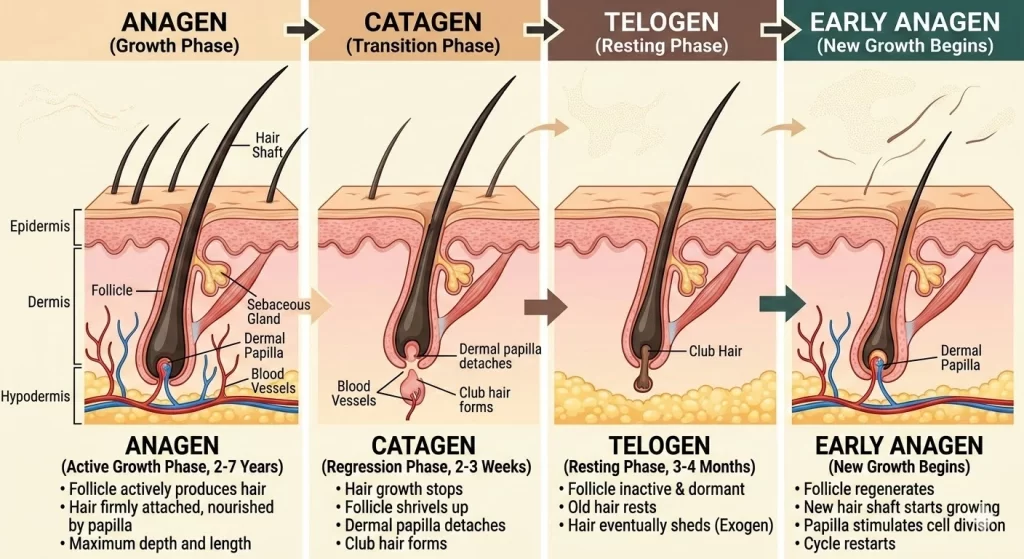
Every hair on your scalp operates on an independent biological clock. Understanding this cycle is the first step in diagnosing hair loss:
Exogen (Shedding Phase): The final stage where the old hair falls out to make room for a new Anagen hair.
Anagen (Growth Phase): Lasting 2 to 7 years, this is when the hair is actively growing from the root. In a healthy scalp, 85-90% of hairs are in this phase.
Catagen (Transition Phase): A short 2-week window where the follicle shrinks and the hair detaches from the dermal papilla (the blood supply).
Telogen (Resting Phase): Lasting about 3 months, the hair remains in the follicle but is no longer growing.
The “Hard Water” & Environmental Impact on Indian Hair
A critical, data-driven gap in Indian hair care is the impact of TDS (Total Dissolved Solids) in tap water.
-
Mineral Calcification: High levels of Calcium and Magnesium in urban Indian water create a “mineral film” on the hair shaft. This makes the hair brittle, prevents moisture from entering, and can lead to “Traction Alopecia” due to the increased weight and friction on the follicle.
-
The Scalp Microbiome: Delhi’s humidity triggers an overgrowth of Malassezia, a yeast-like fungus. This leads to Seborrheic Dermatitis (clinical dandruff), which creates micro-inflammation around the hair bulb, prematurely pushing hairs from the Anagen phase into the Telogen phase.
Clinical Insights: Patterns of Hair Loss
In the Indian context, we categorize hair loss based on biological triggers rather than just “age”:
-
Telogen Effluvium (TE): Sudden, diffuse thinning often triggered 2-3 months after a major systemic stressor (high fever, surgery, or severe nutritional deficiency). This is highly prevalent in India due to common deficiencies in Ferritin (Iron) and Vitamin B12.
-
Androgenetic Alopecia (AGA): Pattern baldness driven by DHT (Dihydrotestosterone) sensitivity. In men, this presents as a receding hairline; in women, it appears as a widening of the central part.
-
Trichodynia: A clinical condition where the scalp feels painful or “sore” to the touch, often signaling active inflammation around the follicles.
Clinical Trichology Metrics (2026)
The minimum **Ferritin (Iron store)** level required for a sustained hair growth phase. Most Indian patients present with levels 50% below this threshold.
Reduction in **Hair Tensile Strength** caused by mineral calcification from hard water exposure, leading to increased “Snap-Breakage.”
The standard biological “delay” between a systemic stressor (illness/diet shift) and visible hair shedding, known as **Telogen Effluvium**.
Hair Health
1. The “Exposome” & Hair: Beyond Genetic Thinning
-
Particulate Matter (PM) Accumulation: Research shows that PM2.5 and PM10 particles don’t just sit on the scalp; they trigger oxidative stress in the follicular bulb. This leads to the premature degradation of the proteins (keratin) that form the hair shaft.
-
The UV-Hair Conflict: While melanin protects the skin, it is less effective at protecting the hair cuticle from UV-induced photodamage. In the Indian summer, UV radiation leads to the oxidation of amino acids in the hair, causing “Protein Loss” that manifests as extreme frizz and split ends, independent of chemical treatments.
2. Scalp Dysbiosis: The Microbiome Connection
The scalp is a distinct ecosystem. While “Dandruff” is a common term, the clinical reality is Scalp Dysbiosis—an imbalance between Malassezia (fungus) and Propionibacterium (bacteria).
-
The Sweat-Sebum Interaction: In India’s tropical climate, the combination of high sweat (eccrine) and oil (sebum) production alters the scalp’s pH. This shift creates a “biofilm” that can suffocate the follicle, leading to Micro-inflammation.
-
The “Tight Scalp” Syndrome: Chronic inflammation can lead to sub-clinical fibrosis (thickening of the scalp tissue), which restricts blood flow to the dermal papilla. This is why “scalp flexibility” is a key metric in professional trichological exams.
3. Nutritional Trichology: The “Indian Vegetarian” Gap
-
The Ferritin Threshold: While the medical “normal” for Iron (Ferritin) might be low, the Trichological Normal is much higher. A hair follicle often requires a Ferritin level of at least 70 ng/mL to maintain a robust Anagen (growth) phase. Many Indian women operate at 20-30 ng/mL, leading to chronic shedding.
-
The Amino Acid Sync: Hair is 90% protein (Keratin). Diets low in essential amino acids—specifically L-Lysine and Methionine—often found in cereal-based Indian diets, result in “thin” hair diameters, even if the number of hairs remains the same.
4. The “Hard Water” Calcification Data
-
Cationic Interference: Calcium and Magnesium ions in hard water (common in Delhi/NCR) have a positive charge, while damaged hair has a negative charge. This causes the minerals to “stick” to the hair like a magnet, creating a waterproof barrier that prevents conditioners and treatments from penetrating.
-
The Tensile Strength Drop: Studies indicate that hair washed in hard water can show a 20-25% reduction in tensile strength (elasticity) compared to hair washed in soft water, leading to “Snap-Breakage” during routine combing.